PRODUCT DEVELOPMENT
Leading and Doing:
Scaling Design Impact Across a Multi-Team Automotive Product Organization
ROLE
Lead Designer + Coach
DURATION
1 year
TEAM
3 Designers
15 Engineers
OVERVIEW
The Problem
A top-tier automotive company had an existing design team supporting a fleet management product, but without shared systems, clear structure, or a validated direction for where the product needed to go next. Designers were working across multiple product teams without a common foundation, leading to inconsistencies in the UI and gaps in transparency across the organization.
At the same time, the product itself needed a clearer path forward, grounded in real user insight rather than assumption. The engagement was brought in to solve both problems at once: establish the design infrastructure the team needed to work effectively, and define the future state of the product with enough clarity and validation to confidently move into development.
TEAM STRUCTURE
Creating One Core Team
Within this department, there are multiple teams that are supported by our design team. In order to maintain context and transparency, all design work is shared within the entire design team, however there are core designers assigned to each product team. The core designers are the ones responsible for the hand-off of deliverables to their respective teams.

Each team may be at a different stage of their lifestyle and each stage requires different levels of support. Designers are assigned to teams based on the level of support needed during the supported stages.

PLANNING PROCESS
A Research-Driven Path Forward
Through current state analysis and competitive research, we identified the gaps and opportunities shaping the next evolution of the fleet software. Future-state prototypes gave those opportunities a tangible form, which were then pressure-tested through usability testing to validate the direction before development commitments were made. Alongside this, a shift to user modes paired with a detailed needs matrix replaced persona-based thinking — bringing the different customer types into focus and making it easier to align the team around what to build and why.
Current State Assessment
We used usability testing and competitive research to uncover the next shifts of the fleet software.


Rapid Prototyping & Testing
The design shifts came out in our future state wireframes which we used to verify the new direction.

User Modes & Needs
By switching our mindset from personas to user modes in a needs matrix we are able to highlight the commonalities between the different customer types that this client has.

DESIGN SYSTEM
A Tool to Increase Consistency and Transparency
The atomic design system gave the entire team a shared foundation, a common visual language and component structure that every designer worked from, regardless of which team they were supporting. Beyond consistency, the system created transparency across the organization, making it easier for designers to stay aware of what their colleagues were building. It also gave new designers a clear, structured starting point, replacing a steep learning curve with an accessible entry point into the product.

AGILE PRODUCT DEVELOPMENT
Putting Plans into Reality
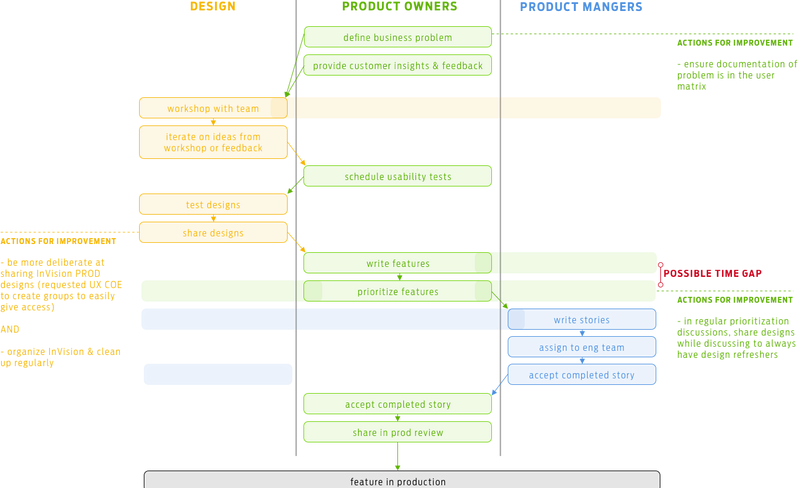
In order to support the development teams, the design team worked with product managers and product owners on all features before doing a hand off with developers. We regularly reflected and identified areas for improvement.
Reflections
This engagement taught me that good leadership in a design organization isn't about having all the answers. It's about maintaining a clear view of two things at once: where you are and where you're going. Without an honest understanding of the present, future planning becomes guesswork. And without a vision for the future, present-day decisions lack direction. Holding both in focus at the same time is harder than it sounds, but it's what allows a team to move with both confidence and purpose.
It also reinforced the value of incremental change. Overhauling a product and a design practice simultaneously is a significant undertaking, and the temptation to try to fix everything at once is real. But sustainable progress comes from layering improvements thoughtfully — building the foundation before the walls, and the walls before the roof. The wins that stuck were the ones that didn't try to do too much too soon.